
Is pressure washing bad for pavers?
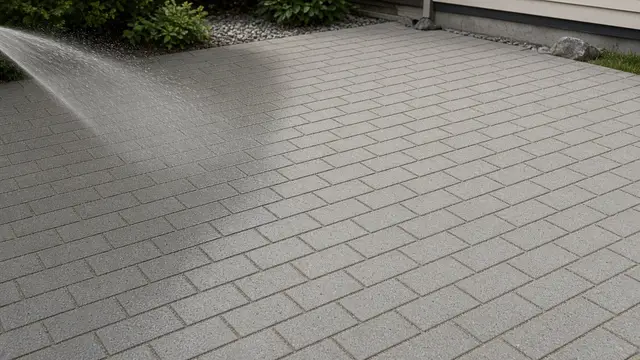
Pressure washing pavers is not bad in itself. Damage comes from how it is done. A narrow tip, too much pressure or a spray aimed straight down the joints can strip out the joint sand and wear the paver surface. Done properly, with a wide fan tip, a low angle, a test patch first and fresh joint sand afterward, it is a normal part of paver care. The Concrete Masonry and Hardscapes Association (CMHA) notes that professionals typically clean pavers with a pressure washer.
This guide explains what goes wrong, how to do it safely, and why the joints matter more than the spray.
What pressure washing can do to pavers
Most pressure-washing damage falls into three groups.
Joint sand loss. The sand in the joints locks the pavers together. CMHA lists excessive cleaning as one cause of joint sand loss. Once it washes out, pavers can loosen and shift, and weeds and moss move into the gaps. Our guide to weeds between pavers explains why full joints matter.
Surface wear. Unilock’s care guide warns that many pressure washers have enough power to expose the aggregate on the surface of a paver. Nozzle style, distance from the surface and pressure all affect the result, and you can’t undo the damage once it happens.
Washed-out bedding sand. Spraying deep into an empty joint can reach the bedding sand under the pavers. Unilock cautions that care must be taken not to wash out the sand beneath them.
How to pressure wash pavers without damaging them
If you decide to use a pressure washer, follow the paver maker’s instructions first. These points come from manufacturer and industry guidance.
- Test first. Unilock recommends testing on a few spare pavers left over from the installation. If you don’t have any, use a hidden corner.
- Use a fan tip, not a pinpoint tip. CMHA notes that a nozzle with a wide spray covers more area and keeps sand from being washed out of the joints. Techo-Bloc also specifies a fan tip.
- Keep the pressure moderate. Techo-Bloc recommends a low-pressure unit of 1,700 to 2,000 psi. Unilock’s moss guidance says not to rinse on high power.
- Keep the angle low and the wand back. CMHA says a low angle from a wide spray reduces the risk of dislodging joint sand. Unilock suggests about 30 degrees to the surface. Techo-Bloc says at least one foot away at 45 degrees. Use the lower, gentler setting if two guides differ.
- Spray across the joints, not along them. Unilock advises working diagonally so the spray does not run straight down the joint lines.
- Let the cleaner do the work. CMHA describes cleaners applied with a low-pressure sprayer, left to sit, then rinsed off. It also notes that a large amount of water matters more to rinsing than high pressure.
- Control the runoff. Protect nearby plants and turn off sprinklers. CMHA warns that dirty water left to pond in low spots can stain pavers.
The step most people skip: re-sanding
Pressure washing nearly always moves some joint sand. That’s why, for us, the clean is only half of the job.
CMHA’s maintenance guide says to top up the joint sand right away if it has dropped more than 1/2 inch. Sweep dry sand into the dry joints with a wide push broom until they are full to the bottom of the paver bevels, then clear the extra sand from the surface. Unilock gives the same advice: inspect the joints after cleaning and re-sand any that have eroded.
For longer protection, CMHA describes joint sand stabilizers and sealers that help hold sand in the joints. They go on only after the pavers are clean and completely dry. CMHA says to allow at least 24 hours without moisture before most sealers. See should I seal my pavers? for the trade-offs.
What “bad for pavers” usually means
When people say pressure washing ruined their pavers, they usually mean one of two things: the joints are empty, or the surface looks worn. Neither is a mystery.
Empty joints show up as gaps you can dig a finger into, loose pavers that rock when you step on them, and weeds that return weeks after you pull them. Worn surfaces look lighter, chalky or pitted where the spray was held too close. Both are fixable with restoration, but both are also avoidable with the right tip, angle and a re-sand afterward.
When to skip the pressure washer
A pressure washer is not always the best tool. Skip it when:
- The area is a small patio or walkway. CMHA says a cleaner applied by hand, a scrub and a garden-hose rinse do an adequate job there.
- The joints are already low or empty.
- Pavers are loose, rocking or sinking.
- The surface is older or already shows worn, exposed aggregate.
For the hand method, see how to clean pavers without a pressure washer.
What we do on a job like this
Restoration Hardscapes restores the pavers and stone you already have. We do not offer generic cleaning services. A spray rinse is only one step in a restoration.
Through our paver cleaning and re-sanding service, we inspect the pavers, the joints and the base first. Then we deep clean the surface with a method chosen for your pavers and the stains on them, so the surface is cleaned without being worn away. We clear out the old joint material and refill the joints with fresh sand so the pavers stay tight. Where it suits the surface, we recommend a sealer to help protect the result.
If your pavers have lost their joint sand or the surface looks worn after a past pressure washing, request a quote and tell us about your surface.
Common questions
Is pressure washing bad for pavers?
Not by itself. The Concrete Masonry and Hardscapes Association (CMHA) says professionals routinely use pressure washers on pavers. Damage comes from the wrong nozzle, too much pressure or spraying straight into the joints, which washes out sand and can wear the surface.
What PSI should I use to pressure wash pavers?
Follow your paver maker's guidance. Techo-Bloc recommends a low-pressure unit of 1,700 to 2,000 psi with a fan tip. Unilock says nozzle style, distance and pressure all affect the result, and suggests testing on spare pavers first.
What angle should I hold the wand at?
Keep it low. CMHA says a low angle from a wide spray reduces the risk of dislodging joint sand. Unilock recommends a fan nozzle at about 30 degrees to the surface. Techo-Bloc says at least one foot away at a 45 degree angle.
Do I need to re-sand pavers after pressure washing?
Often, yes. CMHA lists excessive cleaning as a cause of joint sand loss and says to top up the sand right away if it has dropped more than 1/2 inch. Unilock says to re-sand any eroded joints after cleaning.
Can I clean pavers without a pressure washer?
Yes. CMHA says small patios, walks and driveways can be cleaned by hand with a cleaner, a scrub brush and a garden hose.
Sources
Keep reading
Your hardscape is worth restoring
Tell us about your patio, driveway, walkway or pool deck. We will arrange a look and give you a quote.